

Japan’s convenience stores, known as “Konbini,” are amazing. They are clean, convenient, and have delicious food. However, for many Japanese learners, the register can be a scary place.
The staff often speak very fast, and they ask many questions! “Do I have a card? Do I want a spoon? Do I need a receipt?”
But don’t panic. Even if the sentence is long, you just need to catch the “Keywords.” In this guide, we will introduce the 4 most common questions you will hear at a Konbini and how to answer them smoothly.
Shizuoka Guide: Fuji & Tea / 富士山とお茶の旅
Contents
Point Card (ポイントカード)
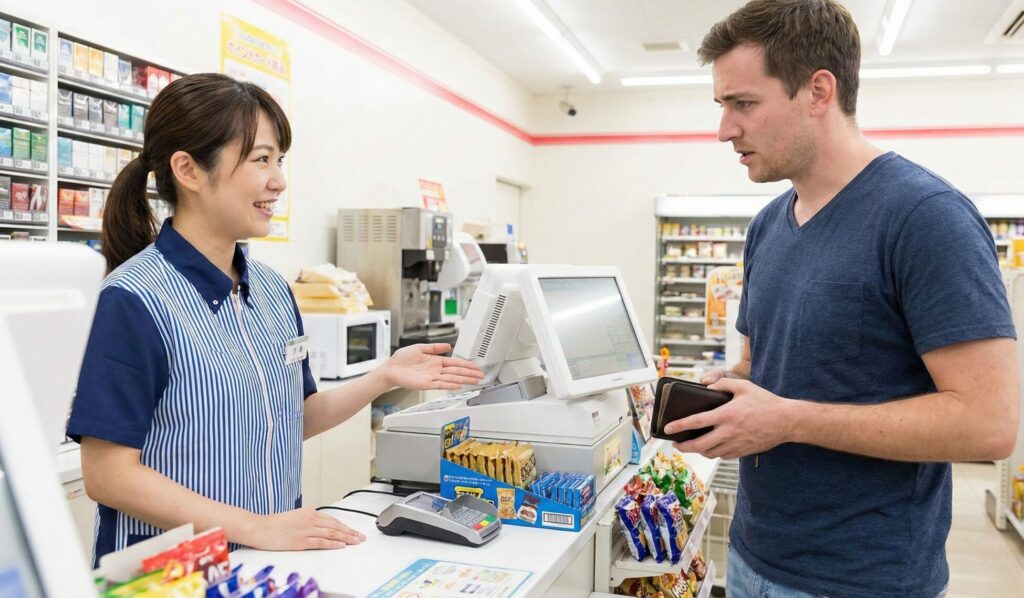
First, the staff will usually ask if you have a loyalty point card (like T-Point, Ponta, or d-Point).
What you will hear:
- Standard Phrase: 「ポイントカードはお持ちですか?」 (Pointo ka-do wa omochi desu ka?) Meaning: Do you have a point card?
- Variation: 「ポイントカードはよろしいですか?」 (Pointo ka-do wa yoroshii desu ka?) Meaning: Do you need [to use] a point card?
WANOKOE Tip: Just listen for the word “Pointo” (Point). Even if you don’t understand the whole sentence, if you hear “Pointo,” get ready to answer.
How to answer:
- No: 「ないです」 (Nai desu.) / 「持っていません」 (Motte imasen.)
- Yes: (Silently show them the card or the app screen)
Plastic Bag (レジ袋)
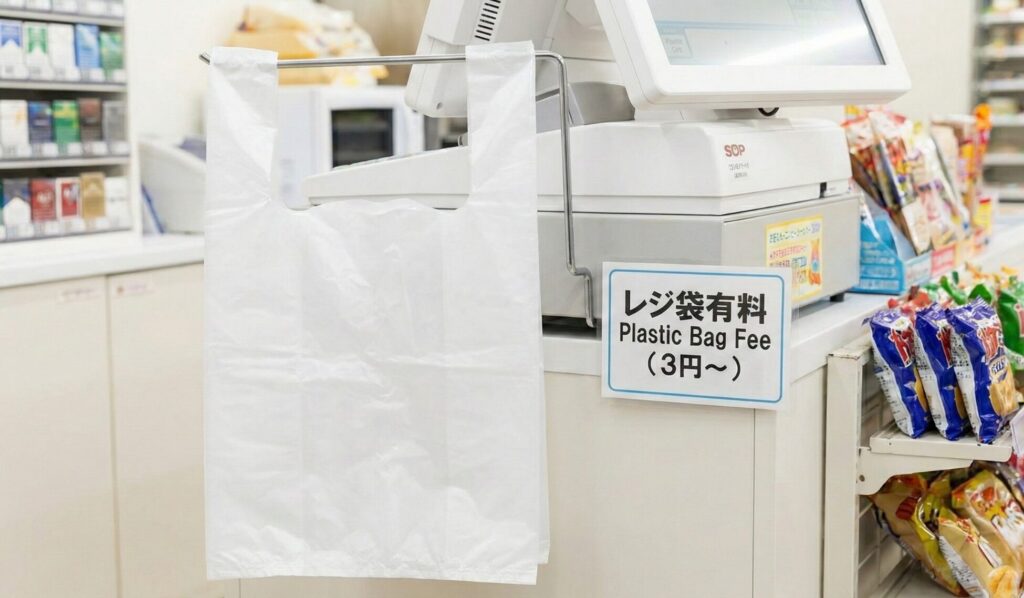
In Japan, plastic bags are not free (usually 3-5 yen). You need to tell them if you want one.
What you will hear:
- Standard Phrase: 「レジ袋はご利用ですか?」 (Reji bukuro wa goriyou desu ka?) Meaning: Do you need a plastic bag?
- Variation: 「袋にお入れしますか?」 (Fukuro ni oire shimasu ka?) Meaning: Shall I put it in a bag?
WANOKOE Tip: Listen for “Fukuro” (Bag).
How to answer:
- Yes: 「はい、お願いします」 (Hai, onegaishimasu.) (Yes, please.)
- No: 「いいえ、大丈夫です」 (Iie, daijoubu desu.) (No, thank you.)
Warming Up Food (温め)
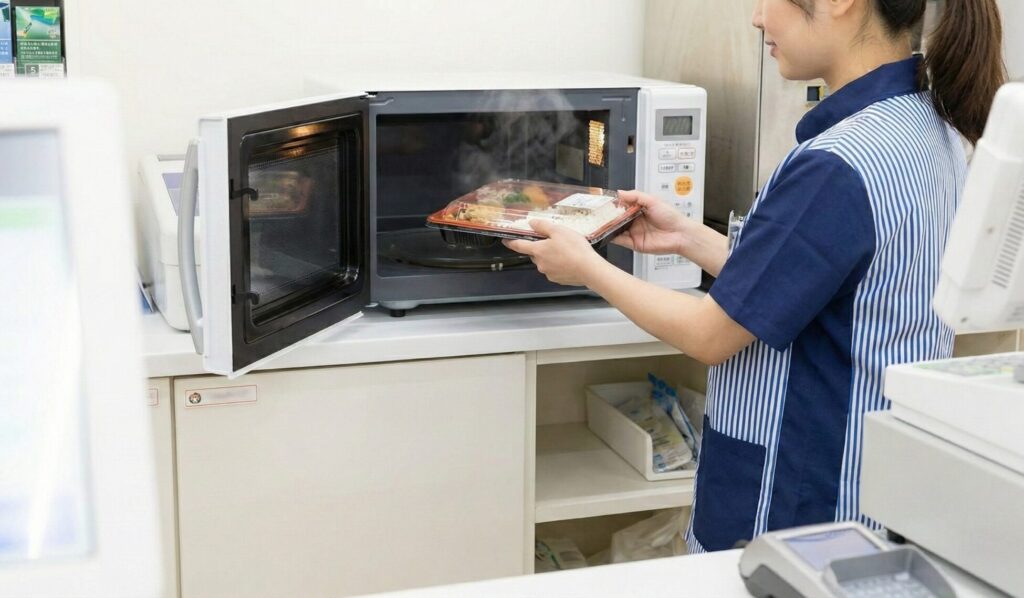
If you buy a Bento box (lunch box), pasta, or soup, they will ask to microwave it for you.
What you will hear:
- Standard Phrase: 「こちら温めますか?」 (Kochira atatamemasu ka?) Meaning: Shall I warm this up?
- Variation: 「お温めしますか?」 (Oatata me shimasu ka?) Meaning: Shall I warm this up?
- Variation: 「レンジはご利用ですか?」 (Renji wa goriyou desu ka?) Meaning: Do you want to use the microwave?
WANOKOE Tip: Listen for “Atatame” (Warm) or “Renji” (Microwave).
How to answer:
- Yes: 「はい、お願いします」 (Hai, onegaishimasu.)
- No: 「そのままでいいです」 (Sono mama de ii desu.) (It is fine as it is.)
Payment (お支払い)
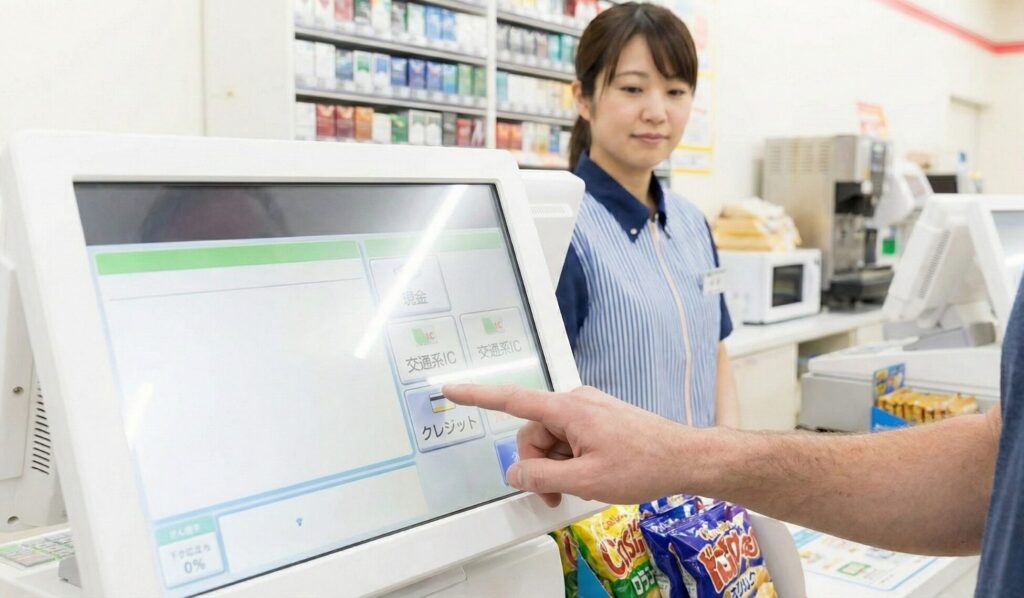
Finally, it’s time to pay. In many modern Konbini (like 7-Eleven or Lawson), the staff might not take your cash directly. You often need to select your payment method on the touch screen.
What you will hear:
- Standard Phrase: 「お支払い方法はいかがなさいますか?」 (Oshiharai houhou wa ikaga nasaimasu ka?) Meaning: How would you like to pay?
- Variation: 「画面からお選びください」 (Gamen kara oerabi kudasai.) Meaning: Please choose from the screen.
WANOKOE Tip: If the staff points at the register screen, don’t wait! Look at the screen and press the button for your payment method.
How to answer (or what to press):
Adding “de” (by) makes your Japanese sound more polite and natural.
- Cash: 「現金で」 (Genkin de)
- Credit Card: 「クレジットで」 (Kurejitto de) Note: Say “Kurejitto,” not just “Card.” In Japan, “Card” often sounds like “Point Card.”
- IC Card (Transport): 「Suicaで / Pasmoで」 (Suica de / Pasmo de) Note: Using the specific card name is easiest to understand.
Summary: Don’t worry about grammar!
Japanese clerks use very polite language (Keigo), which makes sentences long and complicated. But the core meaning is simple: Point? Bag? Microwave? Payment?
Focus on catching these keywords. And if you forget everything else, just remember these two magic phrases:
- 「お願いします」 (Onegaishimasu) – Yes, please.
- 「大丈夫です」 (Daijoubu desu) – No, thank you.
With these phrases, you can survive any Konbini in Japan!
Do you want to practice real Japanese conversation?
Reading is helpful, but speaking is different.
At WANOKOE, we role-play real-life situations—like shopping at a Konbini, ordering at an Izakaya, or asking for directions—so you can feel confident during your stay in Japan.
Book a trial lesson today and tell us about your favorite Konbini food!