
If you have ever studied Japanese, you have almost certainly felt the frustration. You know what you want to say, but you freeze and ask yourself: should I use は or が?
You are not alone. Even advanced learners of Japanese struggle with this distinction. Native speakers themselves find it difficult to explain.
In this guide, we will break the difference down step by step, using plain English and real examples. By the end, you will have a clear mental model you can actually use in conversation.
Contents
- 1 First, Understand What These Particles Actually Do
- 2 Understanding は (wa): The Topic Marker
- 3 Understanding が (ga): The Subject Marker
- 4 The Classic Comparison: Seeing は and が Side by Side
- 5 A Practical Rule: Questions and Answers
- 6 Inside Clauses: Always Use が
- 7 Common Mistakes English Speakers Make
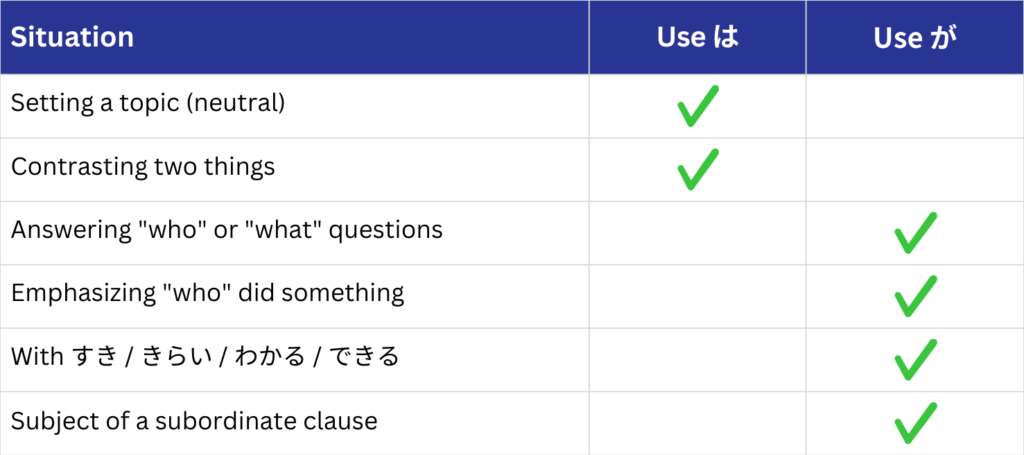
- 8 Quick Reference Table
First, Understand What These Particles Actually Do
In Japanese, particles are small words that follow a noun and tell you what role that noun plays in the sentence. They are a little like prepositions in English, but they work differently.
Both は and が can mark the subject of a sentence, which is why they are so easy to confuse. But their jobs are very different at a deeper level.
The one-sentence summary:
は (wa) marks the topic of the sentence. It signals “as for this thing, here is what I want to say about it.”
が (ga) marks the subject, and specifically highlights who or what performs the action, often with a sense of new information or contrast.
Keep this in mind as we look at each particle in detail.
Understanding は (wa): The Topic Marker
The particle は introduces the topic of conversation. Think of it as saying, “Let’s talk about this.” Once a topic is set, it stays in the listener’s mind, and you do not need to repeat it.
This is similar to how you might start a sentence in English with “As for me…” or “Speaking of the weather…”
Example 1: Introducing a Topic
わたしは がくせいです。
Watashi wa gakusei desu.
I am a student.
(Literally: “As for me, I am a student.”)
Here, わたし (watashi) is the topic. The sentence is simply providing information about “me.” There is no contrast or special emphasis. It is a neutral, factual statement.
Example 2: は for Contrast
One of は’s most important uses is to create contrast. When you use は, you often imply that other things are different.
コーヒーは すきです。でも、こうちゃは きらいです。
Koohii wa suki desu. Demo, koucha wa kirai desu.
I like coffee. But (as for tea), I dislike it.
Notice how using は with both “coffee” and “tea” sets up a clear contrast between the two. This contrastive use of は is very common in everyday Japanese.
Example 3: は for Known Information
は is also used when the topic is something already known, or something the speaker and listener share as common ground.
あの ねこは かわいいですね。
Ano neko wa kawaii desu ne.
That cat (over there) is cute, isn’t it?
Both speakers can see the cat. It is already the shared focus of attention, so は is appropriate here.
Understanding が (ga): The Subject Marker
The particle が marks the grammatical subject of a verb. More importantly, it places a spotlight on that subject. It answers the question “who?” or “what?” with emphasis.
If は says “let’s talk about this topic,” then が says “this, specifically, is the one.”
Example 4: Introducing New Information
When you want to introduce something new, something the listener does not know yet, you use が.
だれが きましたか?
Dare ga kimashita ka?
Who came?
たなかさんが きました。
Tanaka-san ga kimashita.
Tanaka came.
The question asks “who?” and the answer uses が to highlight the subject. The new information is “Tanaka.” Using は here would sound unnatural, because は does not carry this identifying, spotlight function.
Example 5: が in Descriptions and Desires
Certain verbs and adjectives in Japanese always take が instead of は. These include words for wanting, liking, disliking, and ability.
みずが のみたい。
Mizu ga nomitai.
I want to drink water.
にほんごが わかります。
Nihongo ga wakarimasu.
I understand Japanese.
Key rule to memorize:
With verbs like わかる (wakaru) and adjectives like すき (suki), the default particle for the object is が.
(Note: You might see は used here for contrast—e.g., “I like coffee [but not tea]”—but when you’re just starting out, stick with が as your primary tool.)
The Classic Comparison: Seeing は and が Side by Side
Let us now put the two particles next to each other with the same noun, so you can feel the difference clearly.
わたしは やりました。
Watashi wa yarimashita.
I did it. (neutral statement about “me” as the topic)
わたしが やりました。
Watashi ga yarimashita.
I did it. (emphasis: it was ME who did it, not someone else)
In English, we would use stress in our voice to make this distinction. In Japanese, the particle does the work instead.
Think of it this way:
は = “As for me, I did it.” (calm, neutral, topic-setting)
が = “It was I who did it.” (identifying, emphasizing, spotlighting)
A Practical Rule: Questions and Answers
One of the most reliable rules for choosing between は and が involves questions and their answers.
The Question-Answer Rule:
When a question uses が to ask “who” or “what,” the answer also uses が to highlight the new information.
When a question uses は to ask about a topic, the answer often uses は as well, or drops the topic entirely.
Q: だれが うたを うたいましたか?
Dare ga uta wo utaimashita ka?
Who sang the song?
A: マリが うたいました。
Mari ga utaimashita.
Mari sang it.
Q: マリさんは なにを うたいましたか?
Mari-san wa nani wo utaimashita ka?
What did Mari sing?
A: マリさんは Jポップを うたいました。
Mari-san wa J-poppu wo utaimashita.
Mari sang J-pop.
In the first example, “who” is unknown, so が is used in both question and answer. In the second example, Mari is already the established topic, so は is used.
Inside Clauses: Always Use が
Here is an important grammar rule that many textbooks do not explain clearly enough.
When you have a modifying clause or relative clause (a clause embedded inside a larger sentence to describe a noun), the subject of that inner clause must use が, not は.
かれが かいた ほんを よみました。
Kare ga kaita hon wo yomimashita.
I read the book that he wrote.
(“he wrote” is a subordinate clause modifying “book,” so が is required.)
The main topic of the sentence might use は, but inside the embedded clause, が is the correct choice.
Common Mistakes English Speakers Make
Because English does not have this topic-comment structure, learners often make predictable errors. Here are the most common ones.
Mistake 1: Using は when answering a “who” question
Incorrect: だれが きましたか? … たなかさんは きました。
Correct: たなかさんが きました。
The answer to a “who” question must use が to spotlight the new information.
Mistake 2: Overusing が in neutral statements
Incorrect (sounds too emphatic): わたしが にほんじんです。
Correct: わたしは にほんじんです。
Simply introducing yourself uses は. Using が sounds like you are insisting “I, and specifically I, am Japanese,” which is strange in normal conversation.
Mistake 3: Over-relying on を with すき / わかる
Incorrect: えいごを わかります。
Correct: えいごが わかります。
While は is possible for contrast, が is the standard way to express ability or preference.
Quick Reference Table
Use this table as a handy cheat sheet when you are unsure which particle to use.