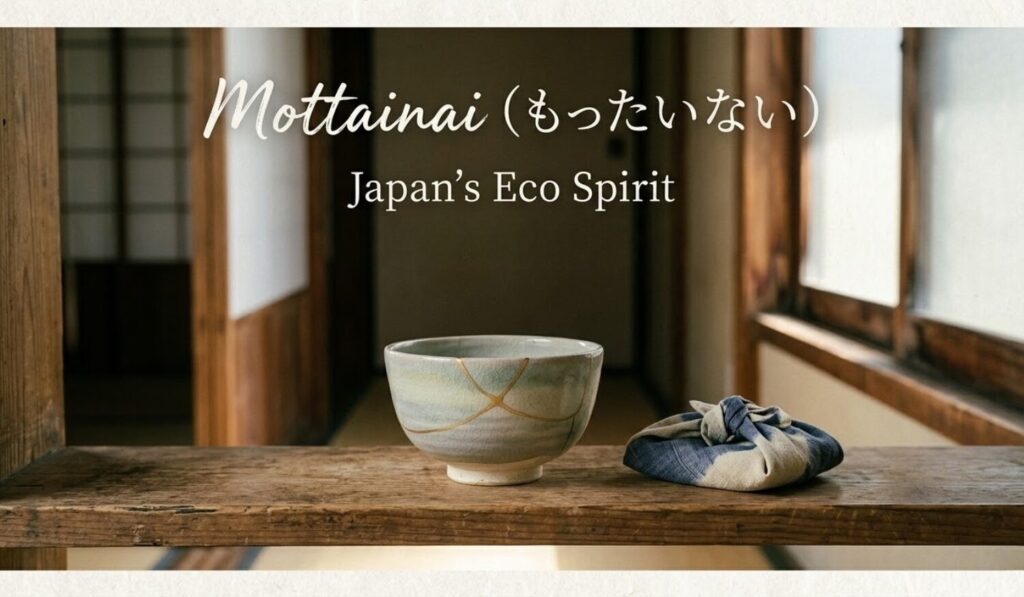
Have you ever hesitated to throw something away, even when it was no longer needed?
In Japan, that feeling has a name: もったいない (mottainai).
This single word carries a deep sense of regret over waste. It is one of those rare Japanese expressions that cannot be perfectly translated into English with just one word.
Understanding mottainai is not just about learning a vocabulary item. It is about understanding
a way of life that has shaped Japanese culture for centuries, and it is becoming more relevant to the entire world today.
Contents
What Does Mottainai Mean?
The word もったいない is a Japanese adjective (い-adjective) that expresses a feeling of
wastefulness or a sense that something valuable is being lost unnecessarily.
A common English approximation is “What a waste!” However, mottainai goes
further. It also includes feelings of gratitude, respect, and regret, all at once. It acknowledges
the value of an object, a resource, or even someone’s effort, and laments that it is being discarded or overlooked.
The word is written in kanji as 勿体無い, though in everyday writing, the hiragana form
もったいない is far more common.
The kanji breakdown gives us a clue to its roots. 勿体 (mottai) refers to the inherent
dignity or essential nature of something. 無い (nai) means “there is not” or “lacking.”
So at its core, the word suggests that something’s true value is being dishonored or ignored.
The History and Cultural Roots of Mottainai
The concept of mottainai is deeply rooted in Japanese history. For much of Japan’s past,
resources were scarce and carefully managed. People repaired broken tools, reused fabric scraps,
and found new purposes for worn-out items as a matter of survival.
This frugality was also influenced by Buddhist and Shinto beliefs, which encourage respect for all
living things and for the natural world. In this worldview, even everyday objects are treated with care, because they embody the effort of the people who made them and the resources of the earth.
Traditional Japanese crafts reflect this spirit clearly. Techniques like kintsugi
(repairing broken pottery with gold) and sashiko (stitching worn fabric to strengthen it)
are beautiful expressions of the mottainai mindset. Rather than discarding what is broken,
these arts celebrate repair and transformation.
This attitude stood in contrast to the rapid consumerism of the 20th century. As Japan modernized, there was a tension between old values of thrift and new habits of mass consumption.
Today, mottainai is being rediscovered as a guiding principle for sustainable living.
Mottainai Goes Global
In 2005, Kenyan environmental activist and Nobel Peace Prize laureate Wangari Maathai
visited Japan. She encountered the word mottainai and was immediately struck by how powerfully
it captured the values of environmental conservation.
Maathai adopted mottainai as an international environmental slogan, connecting it to the
4 Rs: Reduce, Reuse, Recycle, and Respect. She argued that the Japanese word uniquely expressed all four of these ideas in a single term, something no English word can do.
Her campaign brought global attention to this Japanese concept. It showed that mottainai
is not just a cultural curiosity. It is a practical and philosophical framework for responding to
climate change and overconsumption.
How to Use Mottainai in Japanese
Now that you understand the meaning and culture behind the word, let’s look at how it is actually
used in everyday Japanese conversation.
As an い-adjective, mottainai follows standard Japanese grammar rules.
It can end a sentence on its own, modify a noun, or appear in more complex grammatical structures.
Basic Sentence Ending
The simplest use is as a sentence-final predicate, expressing that something is a waste or a pity.
まだ食べられるのに、捨てるのはもったいない。
Mada taberareru noni, suteru no wa mottainai.
“It’s still edible, so it’s a waste to throw it away.”
そんな才能を使わないなんて、もったいない。
Sonna sainou wo tsukawanai nante, mottainai.
“Not using such talent is such a waste.”
As an Exclamation
In casual conversation, mottainai is often used on its own as a short exclamation, similar to saying “What a waste!” in English.
A: このケーキ、食べきれないから捨てようかな。
A: Kono keeki, tabekirenai kara suteyo kana.
“A: I can’t finish this cake, so maybe I’ll throw it away.”
B: えっ、もったいない!
B: E, mottainai!
“B: What? That’s such a waste!”
Expressing Regret About an Opportunity
One important nuance of mottainai is that it applies not only to physical objects.
It can also express regret when a good opportunity, a skill, or someone’s potential is wasted.
This is a culturally specific usage that learners should know.
そのチャンスを逃すなんて、本当にもったいなかった。
Sono chansu wo nogasu nante, hontou ni mottainakatta.
“It was truly a shame to miss that opportunity.”
彼女の英語力、もったいないくらい使われていない。
Kanojo no eigo-ryoku, mottainai kurai tsukawarete inai.
“Her English ability is going to waste. It’s such a shame.”
Politeness and Humility (Honorific Usage)
In formal or polite contexts, mottainai can also carry a sense of humility.
When someone receives a compliment or a generous gift, they might use it to express that
such kindness is more than they deserve.
そのようなお言葉は、もったいないです。
Sono you na okotoba wa, mottainai desu.
“Such kind words are more than I deserve.” (Humble and formal)
This usage is more formal and somewhat old-fashioned, but you may still encounter it in business
settings or traditional ceremonies.
Grammar Notes for Learners
Because mottainai is an い-adjective, it follows the same conjugation patterns as adjectives like atsui (hot) or takai (expensive).
| Form | Japanese | Meaning |
|---|---|---|
| Plain present | もったいない | It is a waste |
| Polite present | もったいないです | It is a waste (polite) |
| Plain past | もったいなかった | It was a waste |
| Polite past | もったいなかったです | It was a waste (polite) |
| Negative | もったいなくない | It is not a waste |
| Te-form | もったいなくて | Being a waste, and… |
| Adverbial form | もったいなく | Wastefully |
A very common pattern to know is 〜のはもったいない, which means
“It is a waste to do [something].” The nominalizer の turns the preceding verb phrase
into a noun, making it the subject of the sentence.
使わないのはもったいない。
Tsukawanai no wa mottainai.
“It is a waste not to use it.”
Mottainai in Daily Japanese Life
The mottainai spirit shows up in many everyday practices in Japan. Recognizing these will
help you connect the language to real culture.
Food: Ironically, modern Japan actually struggles with a high rate of food waste. However, the traditional mottainai spirit is driving a strong movement to fix this. Supermarkets now heavily discount items nearing their expiration dates, and convenience stores face increasing public pressure to reduce the disposal of unsold food. Households are also encouraged to creatively reuse leftovers in their next meals.
Clothing and textiles: The tradition of furoshiki (wrapping cloth) reflects
mottainai thinking. A single cloth is used again and again for wrapping gifts, carrying groceries,
or packing luggage, replacing the need for disposable bags or paper.
Second-hand culture: Japan has a thriving second-hand market. Stores like Hard Off
and Book Off allow people to buy and sell used goods at fair prices. Online platforms like
Mercari started in Japan and reflect the same mottainai ethos.
Stationery and school supplies: Japanese children are taught from an early age to
use their pencils until they are almost too short to hold. Wasting school supplies is often gently
corrected by teachers with the word mottainai.
Common Mistakes and Tips for Learners
Learners of Japanese sometimes confuse mottainai with simple expressions of refusal or
dislike. Here are a few points to keep in mind.
Tip 1: Mottainai is about value, not preference. When you say something is
mottainai, you are saying it has worth that should not be discarded. It is not the same as
saying you personally dislike throwing things away.
Tip 2: The word carries an emotional weight. Using it shows that you recognize the
intrinsic value of something. Japanese speakers will appreciate hearing this word from a foreign learner,
because it signals genuine cultural understanding.
Tip 3: Do not overuse it. In natural conversation, mottainai appears when
there is a real sense of regret or waste. Using it casually for very minor things might sound slightly
unnatural or even sarcastic in some contexts.
A: このジャケット、もう着ないから捨てようと思って。
A: Kono jaketto, mou kinai kara suteyo to omotte.
“A: I’m thinking of throwing away this jacket because I don’t wear it anymore.”
B: もったいないよ!フリマアプリで売れるよ。
B: Mottainai yo! Furima apuri de ureru yo.
“B: That’s such a waste! You could sell it on a secondhand app.”
Conclusion
もったいない is far more than a convenient vocabulary word. It is a window into Japanese values, history, and daily life. Learning this word means learning to see the world the way many Japanese people do: with a deep respect for resources, effort, and the interconnectedness of people and things.
As global awareness of environmental issues continues to grow, the wisdom embedded in mottainai feels more timely than ever. The Japanese language has given the world a simple, memorable way to name the feeling that we should all be feeling more often.
The next time you are about to throw something away, pause for a moment and ask yourself:
is this really mottainai? You might surprise yourself with what you decide to keep, repair, or pass along to someone else.