

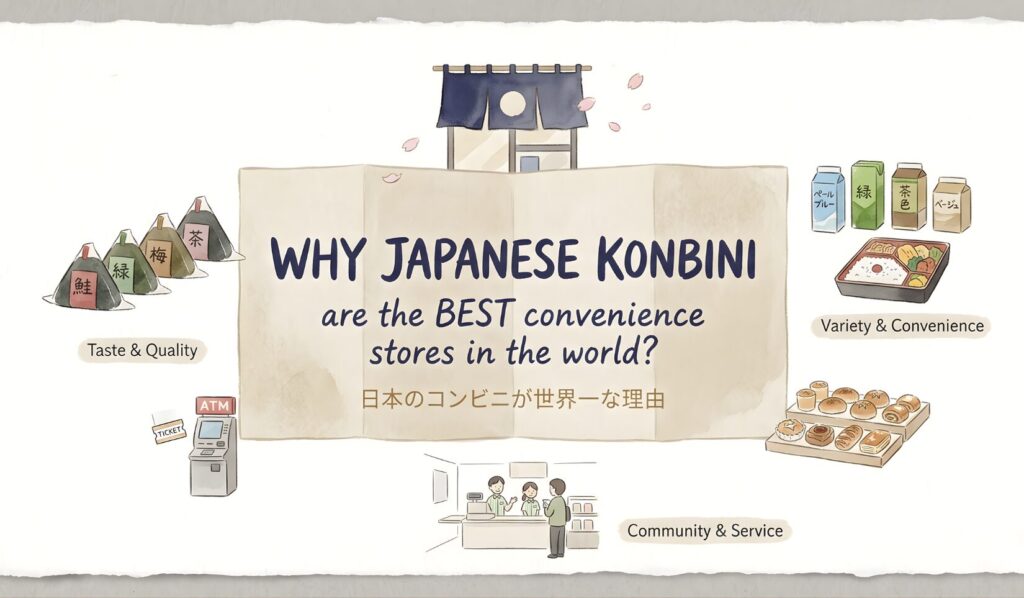
If you have ever visited Japan, you already know the feeling. You step into a brightly lit shop on a quiet street corner at midnight, and somehow, everything you could possibly need is right there in front of you.
Japanese convenience stores, called コンビニ (konbini), are not just places to grab a snack. They are a cornerstone of daily life in Japan, admired by travelers and locals alike for their quality, efficiency, and remarkable variety.
In this article, you will learn why konbini have earned their legendary reputation, what makes them uniquely Japanese, and which items you absolutely must try on your next visit.
Contents
- 1 Section 1: The Big Three Konbini Chains
- 2 Section 2: Why Konbini Are Truly the Best in the World
- 3 Section 3: Konbini and Japanese Culture
- 4 Section 4: What You Absolutely Must Buy at a Japanese Konbini
- 5 Section 5: Practical Tips for Your First Konbini Visit
- 6 Quick Reference: Konbini Japanese Vocabulary
Section 1: The Big Three Konbini Chains
Japan has dozens of konbini brands, but three chains dominate the country and are found on almost every major street corner.
1. セブン-イレブン (Seven-Eleven Japan)
With over 21,000 stores across Japan, Seven-Eleven is the largest konbini chain in the country. It is widely regarded as having the highest quality food, especially its onigiri and sandwiches.
2. ファミリーマート (FamilyMart)
Known affectionately as ファミマ (Famima), this chain is beloved for its fried chicken, called ファミチキ (Famichiki), and its creative seasonal menu items.
3. ローソン (Lawson)
Lawson is famous for its premium desserts and Uchi Cafe sweets line. It also tends to stock a wider range of health-focused and organic products.
Each chain has loyal fans who argue passionately about which one is best. Part of the fun of being in Japan is trying all three and forming your own opinion.
Section 2: Why Konbini Are Truly the Best in the World
The word “convenience store” means something very different in Japan compared to the rest of the world. Here is what sets Japanese konbini apart.
The 24/7 Lifeline (Mostly)
The Japanese term for this is 24時間営業 (nijuuyo-jikan eigyo), meaning “24-hour operation.” For decades, the rule was simple: rain, typhoon, or New Year’s Day—it did not matter. The lights were always on.
While this is still true for the vast majority of stores, it is worth noting that a growing number of locations are now shortening their overnight hours or closing on New Year’s Day due to recent labor shortages.
However, even with these modern changes, konbini remain an absolute lifeline for many people living alone or working late-night shifts.
The Food Quality Is Shockingly High
This is the point that surprises first-time visitors the most. The food at Japanese konbini is genuinely delicious. Freshly made sandwiches, warm rice dishes, handcrafted desserts, and perfectly seasoned onigiri are standard. In many other countries, “convenience store food” implies low quality. In Japan, it implies the opposite.
Major konbini chains employ professional food developers and partner with top food manufacturers to create their private-label products. Seasonal menus are updated regularly, which means there is always something new to discover.
They Offer Far More Than Food
Here is a partial list of what you can do at a Japanese konbini:
- Pay utility bills and taxes (公共料金の支払い, koukyo-ryokin no shiharai)
- Send and receive packages via courier (宅配便, takuhaibin)
- Print, copy, and fax documents
- Withdraw cash from ATMs (which accept foreign cards)
- Buy concert and event tickets
- Pick up online shopping orders
- Purchase travel insurance
In one small visit, you can handle tasks that would require multiple separate trips in other countries. This efficiency reflects a core Japanese cultural value: おもてなし (omotenashi), the spirit of wholehearted hospitality and service.
The Staff Service Is Consistently Polite
When you enter any konbini, you will hear the staff greet you with 「いらっしゃいませ!(Irasshaimase!)」, a formal phrase meaning “Welcome!” or “Please come in.”
Useful Phrase at the Register:
Japanese: 袋はご利用ですか? (Fukuro wa goriyou desu ka?)
Meaning: “Would you like a bag?”
Your Answer: はい、お願いします。(Hai, onegaishimasu.) — “Yes, please.”
Staff are trained to be efficient, respectful, and helpful. Even if you do not speak Japanese, the experience is welcoming and easy to navigate.
Section 3: Konbini and Japanese Culture
To understand why konbini are so exceptional, it helps to understand the cultural values woven into every detail of their design.
Japanese society places enormous value on 品質 (hinshitsu), meaning “quality,” and 清潔感 (seiketsukan), meaning “cleanliness.” These are not just corporate policies at a konbini. They are deeply held social expectations. A product that does not meet the standard simply does not stay on the shelf.
There is also the concept of 改善 (kaizen), meaning “continuous improvement.” Konbini products and services are constantly being refined based on customer feedback and sales data. Nothing stays the same for long, because there is always a better version possible.
For learners of Japanese, konbini are also a wonderful place to practice reading. Labels, price tags, signs, and packaging are filled with useful vocabulary and kanji that appear in everyday life.
Konbini Vocabulary Practice:
お弁当 (obento) — a boxed meal
おにぎり (onigiri) — rice ball
スイーツ (suiitsu) — sweets / desserts (from English “sweets”)
レジ (reji) — cash register (from English “register”)
袋 (fukuro) — bag
Section 4: What You Absolutely Must Buy at a Japanese Konbini
This is the section every first-time visitor to Japan needs. The following items are considered essential konbini experiences, recommended by both locals and experienced travelers.
1. おにぎり (Onigiri) — Rice Balls
If you only buy one thing from a konbini, make it an onigiri. These triangular rice balls are wrapped in crisp seaweed and filled with a variety of ingredients.
Popular Flavors:
鮭 (sake) — salted salmon (the most classic choice)
ツナマヨ (tsuna mayo) — tuna with Japanese mayonnaise
梅 (ume) — pickled plum (sour and refreshing)
明太子 (mentaiko) — spicy salted pollock roe
Opening the wrapper correctly is its own small skill. The packaging is designed so that the seaweed stays crispy until you are ready to eat. Follow the numbered steps on the wrapper, and you will have it open in seconds.
2. コンビニスイーツ (Konbini Suiitsu) — Convenience Store Desserts
Japanese konbini desserts have developed a cult following worldwide. The quality rivals that of dedicated patisseries. You will find puddings, cream puffs, roll cakes, cheesecakes, and seasonal parfaits at prices that are almost unbelievably low.
Lawson’s バスチー (Basu-chi), a Basque-style burnt cheesecake, became a social media sensation and is still one of the most sought-after konbini desserts in Japan.
3. ホットスナック (Hot Snacks) — Fried Chicken and Karaage
Hot food counters are a konbini treasure. You’ll find two legendary items here.
-
ファミリーマートのファミチキ (FamilyMart’s Famichiki):
Technically a boneless fried chicken (フライドチキン). It is so juicy and flavorful that many consider it some of the best fried chicken in Japan, competing with specialized restaurants. -
ローソンのからあげクン (Lawson’s Karaage-kun):
The champion of karaage (からあげ) — bite-sized Japanese fried chicken. These are perfectly seasoned nuggets, famous for their unique, limited-edition flavors and cute packaging
4. お弁当 (Obento) — Boxed Meals
A konbini bento box is a complete, balanced meal in a tray. You will find everything from chicken teriyaki to pork katsu sets, alongside rice, pickles, and side dishes.
Asking for a Heated Bento:
Japanese: これ、温めてもらえますか?
Romaji: Kore, atatamete moraemasu ka?
Meaning: “Could you heat this up for me?”
5. ドリンク (Dorinku) — Drinks
The drink section alone is worth a long browse. Japanese konbini stock a remarkable range of beverages, including:
- 缶コーヒー (kan koohii) — canned coffee, available hot or cold
- 緑茶 (ryokucha) — unsweetened green tea (a staple of daily life)
- カルピス (Calpis) — a sweet, milky, fermented soft drink unique to Japan
- 抹茶ラテ (matcha latte) — especially popular from the self-serve coffee machines
Most konbini also have a self-serve coffee machine near the register where you can get a fresh, hot cup of coffee for around 100 yen. It is one of the great bargains in Japan.
6. Seasonal and Limited-Edition Items
One of the great joys of visiting konbini regularly is discovering 期間限定 (kikan gentei) items, meaning “limited time only.” Japan has a strong culture of seasonal eating and seasonal products, so konbini shelves change dramatically with the seasons. Cherry blossom flavors in spring, cold noodles in summer, sweet potato and chestnut in autumn, and hot soups and oden in winter. These limited items are often better than the regular menu, and they disappear quickly.
Section 5: Practical Tips for Your First Konbini Visit
Going to a konbini for the first time can feel slightly overwhelming given how much is available. Here are a few practical pointers to make your visit smooth and enjoyable.
Tip 1: Carry Cash and a Card
Most konbini accept IC cards like Suica or Pasmo for fast, cashless payment. Foreign credit cards are also widely accepted now. However, keeping some small change is always useful.
Tip 2: Use the ATM
Seven-Eleven ATMs in particular are well known for accepting foreign bank cards and offering English-language menus. This is a reliable way to withdraw yen while traveling.
Tip 3: Do Not Eat Inside Without Permission
Many konbini have a small seating area, called an イートインスペース (eat-in space). If there is no seating area, it is polite to eat outside or back at your accommodation. Also, keep in mind Japan’s specific tax rule: Items are taxed at 8% for takeout but 10% for eat-in. If you plan to use the eat-in space, you must declare it at the register before paying.
Tip 4: Check the Expiration Dates
Fresh food at konbini turns over quickly, but it is always a good habit to check the 消費期限 (shohi kigen) (expiration date) label, especially on sandwiches and bento boxes.
Quick Reference: Konbini Japanese Vocabulary
| Japanese | Reading | Meaning |
|---|---|---|
| コンビニ | konbini | convenience store |
| おにぎり | onigiri | rice ball |
| お弁当 | obento | boxed meal |
| スイーツ | suiitsu | sweets / desserts |
| 袋はご利用ですか? | kikan gentei | Would you like a bag? |
| いらっしゃいませ | irasshaimase | Welcome! (formal greeting) |
| 温めますか? | atatame masu ka? | Would you like it heated up? |