

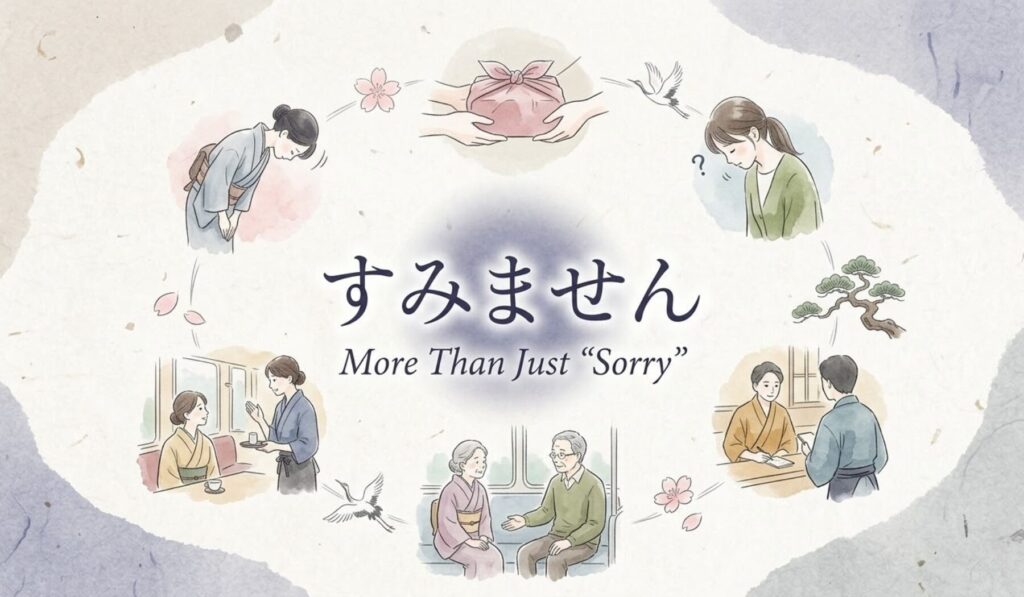
You’ve probably learned that すみません (sumimasen) means “I’m sorry” or “Excuse me.” But if you pay attention in Japan, you’ll hear people saying it constantly—even when no apology is needed.
That’s because sumimasen is much more than just an apology. It’s a highly versatile word tied deeply to Japanese culture and social values.
Let’s break down the main ways to use it in real life, so you can sound more natural and understand the culture a little better.
Contents
- 1 The Literal Meaning: What Does Sumimasen Actually Mean?
- 2 Use 1: “Excuse Me” (Getting Attention)
- 3 Use 2: I’m Sorry” (The Everyday Apology)
- 4 Use 3: Thank You” (Gratitude with Humility)
- 5 Use 4: “Sorry to Bother You” (The Polite Softener)
- 6 Sumimasen vs. Gomen Nasai: What Is the Difference?
- 7 Casual Variations: Suimasen and Suman
- 8 Quick Reference Summary
- 9 More Than Just an Apology
The Literal Meaning: What Does Sumimasen Actually Mean?
Before exploring its uses, it helps to understand what sumimasen literally means. The word comes from the verb 済む (sumu), which means “to be finished,” “to be settled,” or “to be resolved.”
The phrase すみません is essentially a negative form, meaning something like “this is not yet settled” or “this cannot be resolved.” In other words, the speaker is acknowledging that a debt, burden, or imposition has been placed on the other person and cannot be fully repaid.
This underlying nuance is the key to understanding all of sumimasen’s uses. Whether you are apologizing, asking a favor, or thanking someone, the core feeling is the same: “I recognize that I am placing a burden on you, and I am deeply aware of that.”
Use 1: “Excuse Me” (Getting Attention)
This is probably the most common everyday use of sumimasen. When you want to get a stranger’s attention, such as a waiter at a restaurant, a passerby on the street, or a shop assistant, you use すみません just as you would say “Excuse me” in English.
Situation: You want to order food at a restaurant.
Japanese: すみません!メニューをください。
Romaji: Sumimasen! Menyuu wo kudasai.
English: Excuse me! Could I have the menu, please?
Situation: You want to ask a stranger for directions.
Japanese: すみません、駅はどこですか?
Romaji: Sumimasen, eki wa doko desu ka?
English: Excuse me, where is the train station?
Notice that in these cases, you have not done anything wrong. You are simply politely interrupting someone to make a request. In English, we use “Excuse me” for this. In Japanese, すみません fills exactly that role.
Use 2: I’m Sorry” (The Everyday Apology)
Yes, sumimasen is also used as a genuine apology, but it is important to understand its place on the apology scale. Japanese has several levels of apology, and sumimasen sits in the polite but everyday range.
Quick Apology Scale in Japanese:
ごめん (Gomen) – Casual, used with close friends and family.
ごめんなさい (Gomen nasai) – A sincere apology, but still relatively casual.
すみません (Sumimasen) – Polite, suitable for strangers and professional settings.
申し訳ありません (Moushiwake arimasen) – The “Gold Standard” for formal apologies. Use this in business when you’ve made a real mistake. It sounds much more professional than Sumimasen in a corporate context.
Sumimasen is the everyday polite apology you reach for when you have made a small mistake, bumped into someone, or kept someone waiting.
Situation: You accidentally bump into someone on the train.
Japanese: あ、すみません!
Romaji: A, sumimasen!
English: Oh, I’m sorry!
Situation: You are late to a meeting.
Japanese: すみません、遅くなりました。
Romaji: Sumimasen, osoku narimashita.
English: I’m sorry, I’m late.
Use 3: Thank You” (Gratitude with Humility)
This is the use that surprises most English learners the most. Japanese people often say すみません when receiving a favor or a gift, in a situation where an English speaker would simply say “Thank you.”
Why? Remember that core meaning: “this situation cannot be settled.” When someone does something kind for you, you feel a sense of debt or unworthiness. You are recognizing that their kindness has placed you in a position where you owe them something that you cannot fully repay.
Using すみません as a form of thanks actually expresses a deeper, more humble feeling than ありがとう (arigatou) in many contexts. It implies: “I am grateful, and I also feel a little guilty that you had to go out of your way for me.”
Situation: A colleague picks up something you dropped.
Japanese: あ、すみません、ありがとうございます。
Romaji: A, sumimasen, arigatou gozaimasu.
English: Oh, thank you so much (and sorry for the trouble).
Situation: Someone holds the elevator door open for you.
Japanese: すみません!
Romaji: Sumimasen!
English: Thank you! (and sorry for the trouble)
In these situations, saying すみません alone is completely natural. It blends “thank you” and “I’m sorry for the inconvenience” into one expression. This is a uniquely Japanese way of showing consideration for others.
Use 4: “Sorry to Bother You” (The Polite Softener)
Sumimasen is also commonly placed at the beginning of a request, much like saying “Sorry to bother you, but…” in English. It softens the request and shows that you are aware you are asking something of the other person.
Situation: You want to ask your coworker a question.
Japanese: すみません、少し聞いてもいいですか?
Romaji: Sumimasen, sukoshi kiite mo ii desu ka?
English: Sorry to bother you, but may I ask you something?
Situation: You want to pass by someone who is blocking your way.
Japanese: すみません、通ります。
Romaji: Sumimasen, toorimasu.
English: Excuse me, coming through.
Sumimasen vs. Gomen Nasai: What Is the Difference?
This is one of the most common questions learners ask. Both words can mean “I’m sorry,” so when do you use which?
The key difference is that ごめんなさい (gomen nasai) is used only for apologies. It cannot be used to get someone’s attention or to thank someone. Sumimasen, on the other hand, is more versatile and more politely distanced.
Think of it this way:
Gomen nasai is more personal and emotional. It says, “I truly feel bad for what I did.”
Sumimasen is more socially aware and outward-facing. It says, “I recognize the burden this places on you.”
In a business or formal setting, sumimasen is almost always the better choice. Gomen nasai can sometimes sound too casual or too emotionally personal in professional situations.
Casual Variations: Suimasen and Suman
In natural spoken Japanese, you will also hear shortened or casual versions of すみません. It is useful to recognize these so you are not confused in conversation.
すいません (Suimasen)
A very common casual shortening of sumimasen. You will hear this constantly in everyday speech. It carries the same meaning and can be used in the same situations, but it is slightly less formal.
すまん (Suman)
A very casual, masculine-sounding form. This is typically used between close male friends. You might hear it in anime or manga quite often. Avoid using this with strangers or in formal settings.
Quick Reference Summary
Here is a brief overview of the main uses of すみません to keep handy as you practice.
Getting attention: Excuse me (calling a waiter, asking a stranger for help)
Apologizing: I’m sorry (small to medium mistakes in polite settings)
Thanking: Thank you, and sorry for the trouble (receiving help or kindness)
Before a request: Sorry to bother you, but… (softening a favor or question)
Passing by: Excuse me (physically asking someone to move)
More Than Just an Apology
Sumimasen is really about showing consideration for others. When you use it, you’re acknowledging the other person’s time and effort.
Next time you speak Japanese, try using it beyond just saying “sorry”—use it to get attention, show gratitude, or soften a request. It’s one of the quickest ways to make your Japanese sound more natural.